Dr. Katerina Saltiki, Endocrinologist, MD, PhD

Medullary Thyroid Carcinoma
/
Medullary Thyroid Carcinoma and Novel Treatments for Metastatic disease.
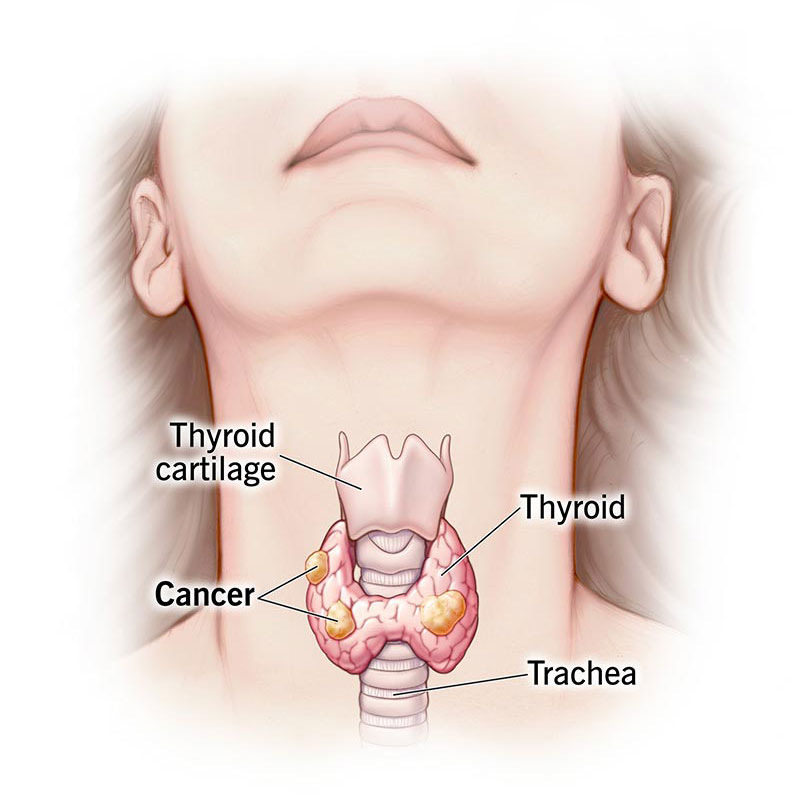
Medullary thyroid carcinoma (MTC) is a rare neoplasm, accounting for 2–10% of all thyroid cancers. It is more aggressive than the more common well-differentiated follicular-derived thyroid carcinomas and has a different cellular origin. MTC is a neuroendocrine tumor arising from the parafollicular C cells of the thyroid, which produce calcitonin.
Calcitonin is the most sensitive biomarker for both the detection and postoperative monitoring of MTC. The routine measurement of calcitonin in the evaluation of thyroid nodules, along with the widespread use of neck ultrasound, has facilitated the early detection of these tumors.
Approximately 25% of MTC cases have a hereditary basis, caused by mutations in the RET proto-oncogene, which can be identified through molecular testing of the patient’s blood DNA. Hereditary MTC is classified under Multiple Endocrine Neoplasia (MEN) syndromes—namely MEN2A, MEN2B—and familial MTC (FMTC), which occurs in the absence of other associated neoplasms.
In MEN2A, MTC is invariably present and is often accompanied by pheochromocytoma (an adrenal tumor) and/or hyperparathyroidism. In MEN2B, patients typically present with a more aggressive form of MTC, and about 50% also develop pheochromocytoma. Additionally, they exhibit characteristic phenotypic features, such as skeletal and nervous system dysplasias. Children with MEN2B should undergo thyroidectomy at a very early age, as invasive MTC and lymph node metastases can already be present by the age of one.
All patients diagnosed with apparently sporadic MTC should undergo genetic screening, since up to 5% may have an unrecognized hereditary form. A specific mutation associated with a milder form of MEN2A has recently been described in Greece. When a pathogenic RET mutation is identified, family members should also be tested. Mutation carriers are advised to undergo prophylactic thyroidectomy at a young age, prior to tumor development.
In hereditary MTC cases, adrenal imaging should be performed to detect pheochromocytoma, which must be surgically removed before thyroidectomy. Evaluation for hyperparathyroidism is also necessary.
The primary treatment for MTC is total thyroidectomy, usually combined with central neck lymph node dissection, following thorough preoperative neck ultrasound assessment. In a significant proportion of patients, postoperative calcitonin remains detectable, indicating persistent disease.
Often, these postoperative calcitonin levels remain low and stable for many years, allowing for long-term survival. In patients with elevated postoperative calcitonin levels, localization of residual disease is crucial for appropriate further treatment. Some patients with markedly elevated calcitonin may have distant metastases, in which case the 10-year survival rate ranges from 20–40%.
Treatment of metastases may include radiotherapy or chemoembolization. Even metastatic MTC may progress slowly and remain stable without systemic treatment. However, certain patients experience rapidly progressive disease, for which effective therapies were unavailable until recently.
Today, such patients are candidates for novel targeted therapies—specifically, tyrosine kinase inhibitors (TKIs). Among these, Vandetanib (Caprelsa) and Cabozantinib (Cometriq) have received approval for the treatment of MTC.
More recently, selective RET inhibitors, such as selpercatinib and pralsetinib, have been approved. Of these, only selpercatinib (Retsevmo) is currently available in Europe, including Greece. These selective RET inhibitors are prescribed exclusively to patients with somatic or germline RET mutations.
They are highly effective and have favorable safety profiles. These drugs represent a therapeutic breakthrough, not only due to their efficacy but also because they are orally administered, well tolerated, and associated with manageable side effects.
These modern therapies have transformed the prognosis of patients with metastatic MTC, offering hope not for a cure, but for long-term disease stabilization. Management of MTC patients requires close monitoring by physicians specialized in administering these advanced therapies.