Dr. Katerina Saltiki, Endocrinologist, MD, PhD

Differentiated Thyroid Cancer
/
Differentiated Thyroid Cancer
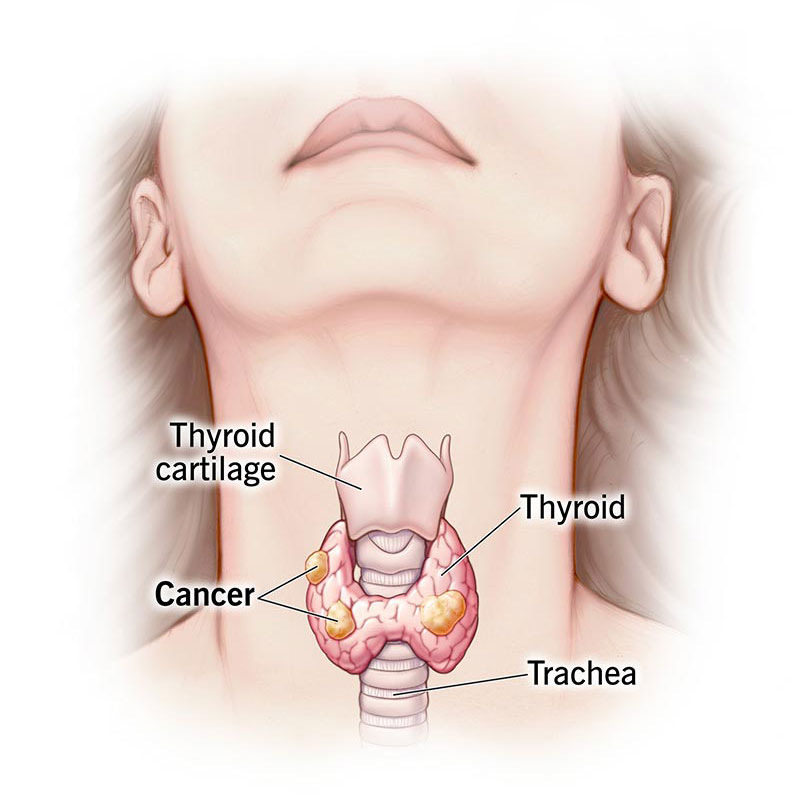
Differentiated thyroid cancer (DTC) is the most common form of thyroid cancer. It includes:
- Papillary thyroid cancer (80–85% of cases): The most frequent and slow-growing type, with excellent prognosis (95% 10-year survival rate). It often occurs after radiation exposure in childhood. There are also rare histological subtypes with more aggressive behavior.
- Follicular and oncocytic cell carcinomas (6–10%): More aggressive, found more often in areas with low iodine.
- Poorly differentiated and high-grade carcinomas (about 6%): More aggressive and at higher risk of recurrence and metastasis.
- Anaplastic thyroid cancer (1–2%): A rare but extremely aggressive form that may develop from previously differentiated cancer. It is usually fatal.
In recent years, thyroid cancer has been diagnosed more often due to routine ultrasound use, especially small tumors (microcarcinomas), which usually have an excellent outcome. Because of their low risk for recurrence, new strategies now avoid overtreatment. For example, lobectomy (removal of only one thyroid lobe) instead of total thyroidectomy may be recommended, or active surveillance (regular monitoring without immediate surgery) for very low-risk microcarcinomas.
How is DTC Treated?
Initial treatment is surgery—total thyroidectomy, sometimes with removal of lymph nodes if cancer has spread.
Depending on the stage and risk of recurrence, radioactive iodine (RAI) may be given afterward:
- In low doses to eliminate remaining thyroid tissue (remnant ablation)
- In higher doses as adjuvant therapy to treat known or suspected disease
This approach lowers the risk of recurrence, helps detect metastases via a whole-body scan, and improves long-term outcomes.
Follow-up and Monitoring
High-resolution ultrasound and thyroglobulin (Tg) blood test are used to detect any remaining cancer tissue.
In some cases (e.g., when patients have antibodies or more aggressive subtypes), Tg levels may not be reliable.
Recombinant TSH (rhTSH, Thyrogen) is often used to stimulate thyroid cells during follow-up or before RAI therapy. This avoids stopping thyroid hormone treatment and helps detect residual cancer. If thyroglobulin is undetectable, this is considered a sign of cure.
In most cases, rhTSH is just as effective as thyroxine withdrawal avoiding hypothyroidism.
After treatment, patients take lifelong thyroid hormone (levothyroxine) to replace normal thyroid function and help prevent cancer recurrence.
When Thyroid Cancer Becomes Advanced
About 5–10% of DTC cases develop metastatic disease (spread to other organs).
In 60–70% of these cases, the cancer no longer responds to radioactive iodine.
Risk factors include older age, aggressive cancer types, genetic mutations (e.g., BRAF), or loss of tumor differentiation.
These patients often need additional therapies. Over the last decade, targeted therapies called tyrosine kinase inhibitors (TKIs) have been approved. These include:
- First-line treatments: Sorafenib and Lenvatinib
- Second-line option: Cabozantinib, which may work even when other TKIs fail
- If specific rare mutations are found (e.g., RET, NTRK, BRAF), newer selective inhibitors may also be used.
These treatments help control the disease, improve outcomes, are taken orally, and are generally well tolerated.
Researchers are also exploring redifferentiation therapies—drugs that may help cancer cells regain their ability to take up radioactive iodine.
The Future of Thyroid Cancer Care
Understanding the molecular profile of each patient’s thyroid cancer helps tailor treatment and develop more effective, personalized therapies. Managing advanced DTC requires care from specialized physicians and multidisciplinary teams.
References
1.Jung CK, Bychkov A, Kakudo K. Update from the 2022 World Health Organization Classification of Thyroid Tumors:A Standardized Diagnostic Approach. Endocrinol Metab (Seoul). 2022;37:703-718.
2.Haugen BR, Alexander EK, Bible KC, Doherty GM, Mandel SJ, Nikiforov YE, Pacini F, Randolph GW, Sawka AM, Schlumberger M, Schuff KG, Sherman SI, Sosa JA, Steward DL, Tuttle RM, Wartofsky L. 2015 American Thyroid Association Management Guidelines for Adult Patients with Thyroid Nodules and Differentiated Thyroid Cancer:The American Thyroid Association Guidelines Task Force on Thyroid Nodules and Differentiated Thyroid Cancer. Thyroid.2016;26:1-133.
3.Pacini F, Fuhrer D, Elisei R, Handkiewicz-Junak D, Leboulleux S, Luster M, Schlumberger M, Smit JW. 2022 ETA Consensus Statement:What are the indications for post-surgical radioiodine therapy in differentiated thyroid cancer? Eur Thyroid J.2022;11:e210046.
4.Fugazzola L, Elisei R, Fuhrer D, Jarzab B, Leboulleux S, Newbold K, Smit J. 2019 European Thyroid Association Guidelines for the Treatment and Follow-Up of Advanced Radioiodine-Refractory Thyroid Cancer. Eur Thyroid J.2019;8:227-245.
5.Karapanou O, Simeakis G, Vlassopoulou B, Alevizaki M, Saltiki K. Advanced RAI-refractory thyroid cancer:an update on treatment perspectives. Endocr Relat Cancer.2022;29:R57-R66.